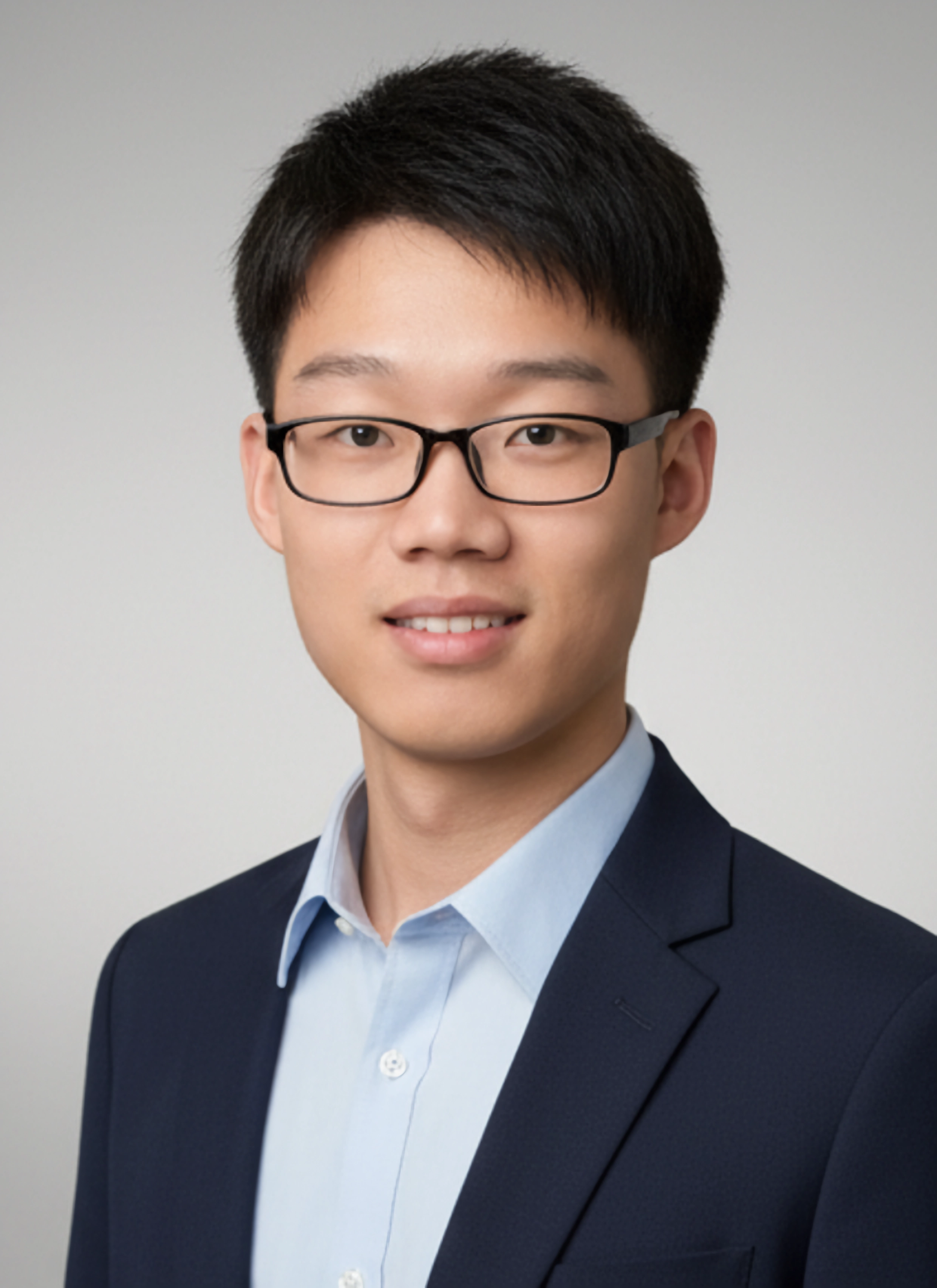
I am a Ph.D. candidate in Computational Mathematics at the School of Mathematics, South China University of Technology (SCUT, 华南理工大学), advised by Prof. Delu Zeng. I received my B.S. degree in Statistics from Wuhan University of Technology (WHUT, 武汉理工大学).
My research focuses on machine learning under distribution shift and limited overlap. I approach these problems through deep generative methods, with applications to information estimation, change-point detection, out-of-distribution detection, and explainable and reliable language-model learning, including preference optimization, on-policy self-distillation, and self-evolving LLM/Agents. I have published papers at top AI conferences (ICLR, NeurIPS, ICML, CVPR) and journals (IEEE T-IM, PR, ESWA, IoTJ, Neurocomputing).
I also serve as a reviewer for JMLR, ICML, NeurIPS, ICLR, CVPR, ECCV, AAAI, UAI, ACM MM, IEEE T-MM, IEEE T-ETCI, IoTJ, ESWA, EAAI…
Feel free to reach me at 📧 weichen.work@qq.com / weichen001.work@foxmail.com.
01 News
- 2026.09: Our paper about flow matching models is accepted to NeurIPS 2026.
- 2026.08: I have joined DSH-better-sidebar as a contributor.
[Details ↓]
- 2026.07: Our paper about implicit variational rejection sampling is accepted to UAI 2026. [Paper ↓]
- 2026.05: Our paper about disentangled preference optimization is accepted to ICML 2026. [Paper ↓]
- 2026.01: Our paper about minimum path variance principle for DRE is accepted to ICLR 2026. [Paper ↓]
- 2025.10: Our paper about diffusion informer for time series modeling is accepted to Expert Systems With Applications (ESWA). [Paper ↓]
- 2025.10: Our paper about wavelet diffusion for time series modeling is accepted to IEEE T-IM. [Paper ↓] [News]
- 2025.09: Our paper about diffusion modeling acceleration is accepted to NeurIPS 2025. [Paper ↓] [News]
- 2025.09: Our paper about normalizing flow is accepted to Pattern Recognition (PR). [Paper ↓]
- 2025.08: Our paper about diffusion models for low-level CV is accepted to Neurocomputing. [Paper ↓]
- 2025.05: Our paper about stable & efficient density ratio estimation is accepted to ICML 2025. [Paper ↓]
- 2022.02: Our paper about efficient continuous normalizing flow is accepted to CVPR 2022. [Paper ↓]
02 Publications
A Machine Learning Under Distribution Shift and Limited Overlap
UAI 2026 Implicit Variational Rejection Sampling
Jian Xu, Shigui Li, Wei Chen, Jiacheng Li, Zhiqi Lin, Delu Zeng, Xinghao Ding, John Paisley, Qibin Zhao
Paper · arXiv · [Bib]
Preprint 2026 One-Step Score-Based Density Ratio Estimation
Wei Chen, Qibin Zhao, John Paisley, Junmei Yang, Delu Zeng*
Paper · Code · [Bib]
ICLR 2026 A Minimum Variance Path Principle for Accurate and Stable Score-Based Density Ratio Estimation
Wei Chen, Jiacheng Li, Shigui Li, Zhiqi Lin, Junmei Yang, John Paisley, Delu Zeng*
Paper · Code · [Bib]
NeurIPS 2025 EVODiff: Entropy-aware Variance Optimized Diffusion Inference
Shigui Li, Wei Chen, Delu Zeng*
Paper · Code · News🎉 · [Bib]
PR 2025 Entropy-informed weighting channel normalizing flow for deep generative models
Wei Chen#, Shian Du#, Shigui Li#, Delu Zeng*, John Paisley
Paper · Code · [Bib]
Preprint 2025 Diffusion Secant Alignment for Score-Based Density Ratio Estimation
Wei Chen, Shigui Li, Jiacheng Li, Jian Xu, Zhiqi Lin, Junmei Yang, Delu Zeng*, John Paisley, Qibin Zhao
Paper · Code · [Bib]
ICML 2025 Dequantified Diffusion-Schrödinger Bridge for Density Ratio Estimation
Wei Chen, Shigui Li, Jiacheng Li, Junmei Yang, John Paisley, Delu Zeng*
Paper · Code · [Bib]
CVPR 2022 To-Flow: Efficient Continuous Normalizing Flows with Temporal Optimization Adjoint with Moving Speed
Shian Du#, Yihong Luo#, Wei Chen#, Jian Xu, Delu Zeng*
Paper · Code · [Bib]
B Applications
ICML 2026 Towards Disentangled Preference Optimization Dynamics: Suppress the Loser, Preserve the Winner
Wei Chen, Yubing Wu, Junmei Yang, Delu Zeng*, Qibin Zhao, John Paisley, Min Chen, Zhou Wang
Paper · Code · [Bib]
IEEE T-IM 2025 Integrating Ordinary Differential Equations with Sparse Attention for Power Load Forecasting
Jiacheng Li, Wei Chen, Yican Liu, Junmei Yang, Zhiheng Zhou, Delu Zeng*
Paper · [Bib]
IEEE T-IM 2025 Generative Self-Supervised Time-Series Forecasting Leveraging Wavelet Diffusion
Jiacheng Li, Wei Chen, Yican Liu, Junmei Yang, Zhiheng Zhou, Delu Zeng*
Paper · News🎉 · [Bib]
ESWA 2025 Diffinformer: Diffusion Informer model for long sequence time-series forecasting
Jiacheng Li, Wei Chen, Yican Liu, Junmei Yang, Zhiheng Zhou, Delu Zeng*
Paper · [Bib]
Neurocomputing 2025 ReciprocalLA-LLIE: Low-light image enhancement with luminance-aware reciprocal diffusion process
Zhiqi Lin, Wei Chen, Jian Xu, Delu Zeng*, Min Chen
Paper · [Bib]
Neural Computing and Applications 2024 DeepAR-Attention probabilistic prediction for stock price series
Jiacheng Li, Wei Chen, Zhiheng Zhou, Junmei Yang, Delu Zeng*
Paper · [Bib]
IEEE IoTJ 2024 Neural ordinary differential equation networks for fintech applications using IoT
Jiacheng Li, Wei Chen, Yican Liu, Junmei Yang, Delu Zeng*, Zhiheng Zhou
Paper · [Bib]
03 Honors and Awards
- 2020 — National Encouragement Scholarship
- 2019 — Outstanding Student Leader (University-level); University Scholarship
- 2018 — Merit Student (College-level); University Scholarship
04 Education


05 Invited Talks
06 Internships

07 Open Source
Selected open-source projects I maintain or contribute to. Live badges below reflect the current state on GitHub.
OpenDRE
Author

A unified framework for density-ratio estimation, combining score-based, neural, and kernel methods for information estimation, change-point detection, and out-of-distribution detection.
DSH-better-sidebar
Contributor


An enhanced sidebar for Overleaf with file-tree, outline and productivity tweaks for the Data Science Hub (DSH) workflow. I contribute as a maintainer-side collaborator.
paper-to-beamer
Author


A lightweight pipeline that turns an academic paper (PDF / markdown source) into a clean Beamer slide deck — extracts structure, generates section/subsection frames, and produces ready-to-compile LaTeX for journal-club or group-meeting talks.